Wednesday, October 7, 2026 · 3:30 to 5:30 pmThe S. Dale High Leadership Center, 1861 William Penn Way, Lancaster, PA 17601
Key ideas from the panel
From October 7, in each panelist's own framework. Recorded with everyone's knowledge.
"If there's a theme for today, I think it's from the chorus: it's not that we don't have enough, it's that we can't get it there."Travis DiNicola, closing the session
Dr. Andrea Hobkirk · Grants
Tell the same logical story every time
The story: the problem is important, my solution makes a big impact, we're the best people to do it. Sort every piece of data into one of those three bins.
The funder's eyes: how does it touch their people, places and priorities? What would look like a slam dunk on their website, and what would they be proud to take to their board?
Make it easy for them: show you already have the resources and the tracking to report back.
The emotion: urgency after the problem, hope after the solution, excitement after why you.
Chad Barger · Individual donors
Statistics tell, stories sell
Story of one: one person, rich detail, a solvable problem. "My $100" can't fix hunger for thousands, but it can help one family for a month.
Lead with the story. Skip the introductory paragraph about the organization, and make the donor part of it: "because of you."
Go find stories: get near the action, put donuts in the volunteer room and ask what great happened this month, or set up a simple story form.
Be creative now and then: a letter from the museum's horse, Applesauce, led to a $1,500 exhibit sponsorship and a new board member. Try annual report postcards with one story on the back.
Timing: September is for story finding. Chad noted about 30% of giving happens in the last six weeks of the year.
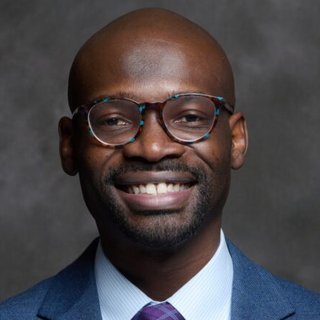
Dr. Jeff Bullock · AI
Capture, Connect, Direct
Capture: record with an AI notetaker, and always tell people first. Pennsylvania requires everyone's consent.
Connect: link Claude or ChatGPT to your Drive, email or CRM. On a personal plan, turn off the setting that lets them train on your data.
Direct: talk, don't type. Give your goal, your number, your deadline, and ask for a conservative plan.
Live demo: a Lancaster County food-rescue nonprofit shared its year-long goal on stage. Using Andrea's logic and Chad's story of one, AI drafted a fundraising plan and a custom song in minutes.
Then read it. AI drafts, you think and verify. Don't hand over the thinking.
From the Q&A
Urgency without sounding desperate: stay positive and show how much better things get (Andrea); tell the success story, then the need, and use a matching gift deadline (Chad); save the true emergency appeal for rare moments (Travis).
Telling stories when privacy rules apply: change names and say so, or invite clients who already speak publicly (Chad and Andrea).
Using AI openly: a short disclosure that explains why you use it, more time for the mission, earns trust (Chad).
Agenda
3:30 pmNetworking and light refreshments
4:00 pmWelcomeRobin Stauffer, President, High Foundation
4:15 pmWorkshop
5:15 pmQ&A
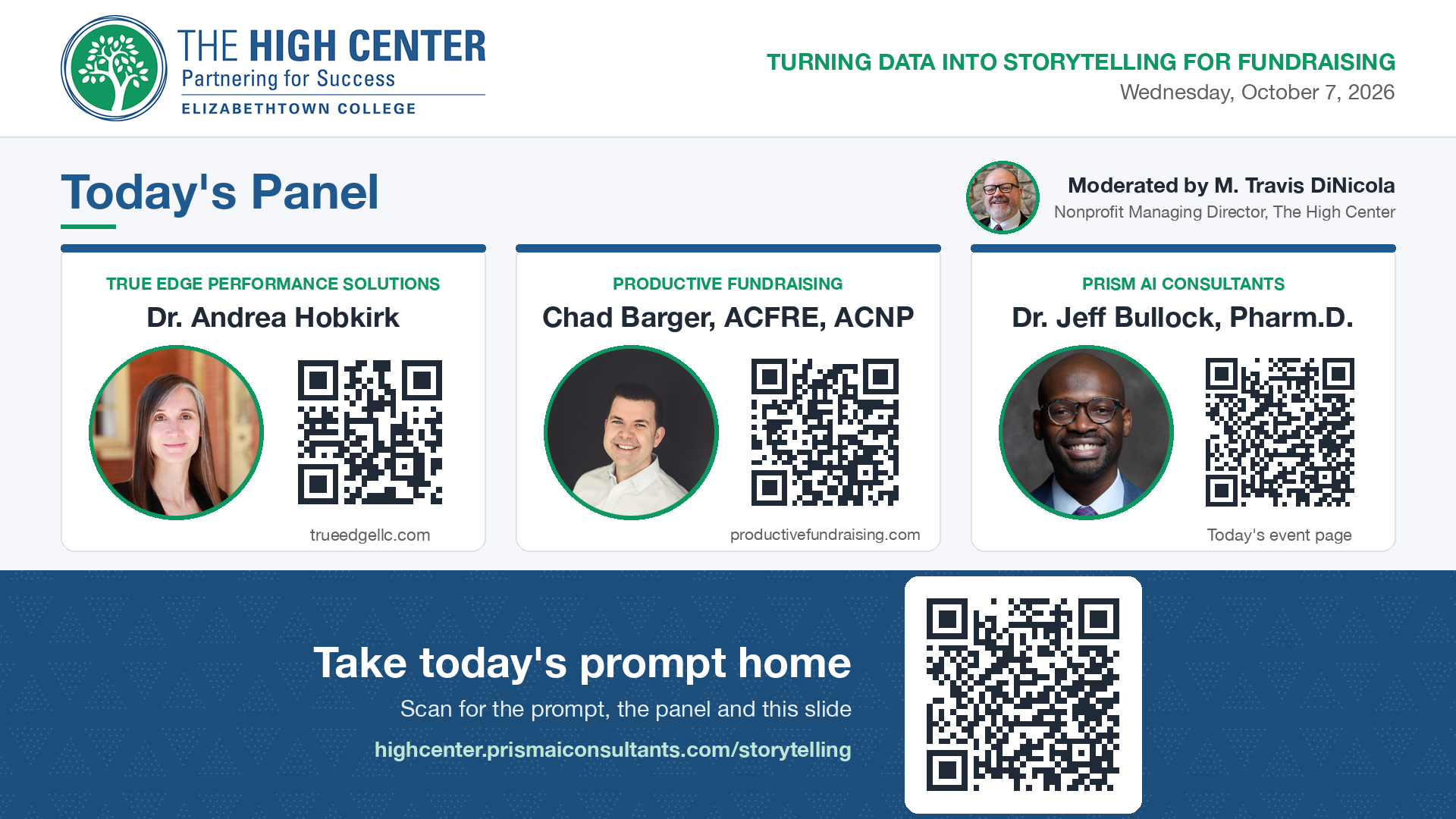
Your panel
Three practitioners, one question: how do you turn the numbers you already have into a story a funder or donor acts on?
Your moderator
M. Travis DiNicola
Nonprofit Managing Director, The High Center
True Edge Performance Solutions
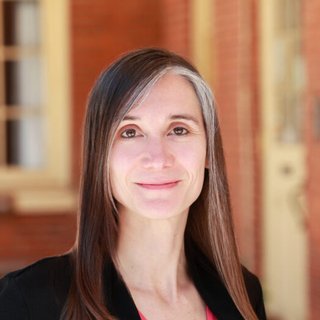
Dr. Andrea Hobkirk
Licensed psychologist, business psychologist and behavioral scientist
The prompt from the live demo, ready for your own story. It works in Claude, ChatGPT or Gemini.
Record yourself telling one real story from your organization. A phone voice memo or any transcription app is fine.
Copy the prompt below, paste it into your AI tool, then paste your transcript where it says to.
Edit the drafts in your own voice. Anywhere it says [NEED THEIR DATA], fill in your real number.
The prompt
You are my fundraising team: a grant writer, a direct-mail fundraising copywriter, and a storyboard artist.

CONTEXT: Below is a transcript of me telling a real story from our organization. Use the ideas of two fundraising experts:
- Dr. Andrea Hobkirk: (1) tell a logical story with your data: the problem is important, my solution makes a big impact, we're the best people to do it. (2) Think from your funder's perspective: how does it affect the funder's people, places and priorities. (3) Make sure the data draws the right emotion: urgency, hope, excitement.
- Chad Barger: a story framework. A compelling story about ONE person, place or thing; rich detail that paints a vivid picture; a solvable problem, something "my $100 donation can help fix." His best example: a donor letter written in the voice of the museum's horse.

ISSUE: Our organization has the data and the story, but no time to turn it into fundraising copy.

GOAL: Give us three drafts we could edit and send this week, built only from what is in the transcript.

COMMAND: Output, in this order:
1. A 6-frame storyboard (frame number, what we see, the one line of copy) for a 60-second donor video, following Chad's framework.
2. A one-page donor letter following Chad's framework, ending with a specific "$100 helps fix ___" ask.
3. The same letter rewritten in a surprising narrator's voice (an object, place or animal from the story), like Chad's horse letter.
4. A grant-paragraph version that answers Andrea's three funder questions.
5. A table: every number or fact used, and the exact line in the transcript it came from. If a number is not in the transcript, write [NEED THEIR DATA] instead of inventing one. Never invent a statistic.

TRANSCRIPT:
[PASTE YOUR TRANSCRIPT HERE]
Built on Dr. Andrea Hobkirk's three funder questions and Chad Barger's story framework, both from today's panel.
Want help turning this into your year-end appeal? Book a session with Dr. Jeff, no charge.